Choosing the right aluminum truss for concert stage lighting starts with understanding the equipment load, unsupported span, support arrangement, and installation environment. A suitable truss must safely support lighting fixtures, cables, rigging hardware, and other suspended equipment while maintaining the required structural stability. For medium and large concerts, square aluminum box trusses are commonly considered because their four-chord structure provides a practical framework for multi-point lighting installations. However, the final selection must always be based on product-specific load data and the complete structural configuration.
For stage contractors, event production companies, and lighting rental businesses, choosing an aluminum lighting truss is not simply a matter of selecting the largest available size. Truss dimensions, aluminum alloy, tube specifications, connection methods, and load distribution all influence performance. Understanding these factors helps buyers select a system that matches the actual demands of a concert rather than paying for an unsuitable or unnecessarily oversized structure.
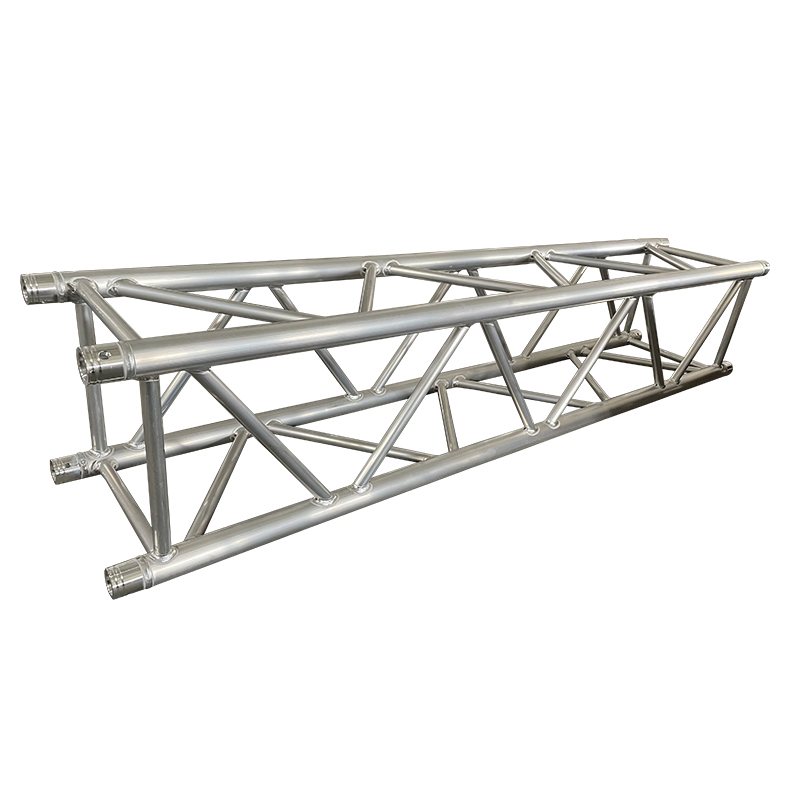
Aluminum spigot box truss used in stage and event structures.
Understand Your Concert Lighting Requirements First
The first step in choosing a stage lighting truss is to identify exactly what the structure needs to support. Concert lighting systems often combine different fixture types, each with its own weight, mounting arrangement, and operational requirements.
Before selecting a truss, prepare the following information:
- Lighting equipment: List all moving head lights, LED wash lights, spotlights, strobes, and other fixtures.
- Equipment weight: Record the weight of each fixture, including clamps, brackets, safety cables, and associated accessories.
- Truss span: Determine the distance between supporting points and identify any unsupported sections.
- Load positions: Establish where individual fixtures will be installed and whether heavy equipment is concentrated in certain areas.
- Installation height: Confirm the required lighting position and the available rigging or ground-support arrangement.
- Operating environment: Identify whether the structure will be used indoors, outdoors, or as part of a temporary touring installation.
These details are essential because a truss carrying evenly distributed lighting equipment experiences different structural demands from one carrying several heavy fixtures at specific positions. The total equipment weight alone is not enough to determine whether a truss is suitable.
Choose the Appropriate Aluminum Truss Size
Truss size affects structural stiffness, load distribution, and the range of applications a system can support. A larger cross-section may offer advantages for demanding configurations, but it does not automatically guarantee a higher safe working load. Tube dimensions, brace arrangements, alloy specifications, connection details, and span conditions must also be evaluated.
For concert lighting applications, aluminum box trusses are commonly selected for overhead lighting grids, main stage beams, and other load-bearing structures. The four-chord configuration provides structural depth and multiple connection positions for compatible accessories and lighting equipment.
GF-Truss offers several aluminum truss sizes for different event requirements. Its 400×400mm Concert Stage Lighting Aluminum Spigot Truss is specifically listed for medium to large events requiring higher loading capacity. The product offers two-sided or four-sided brace tube configurations depending on the application.
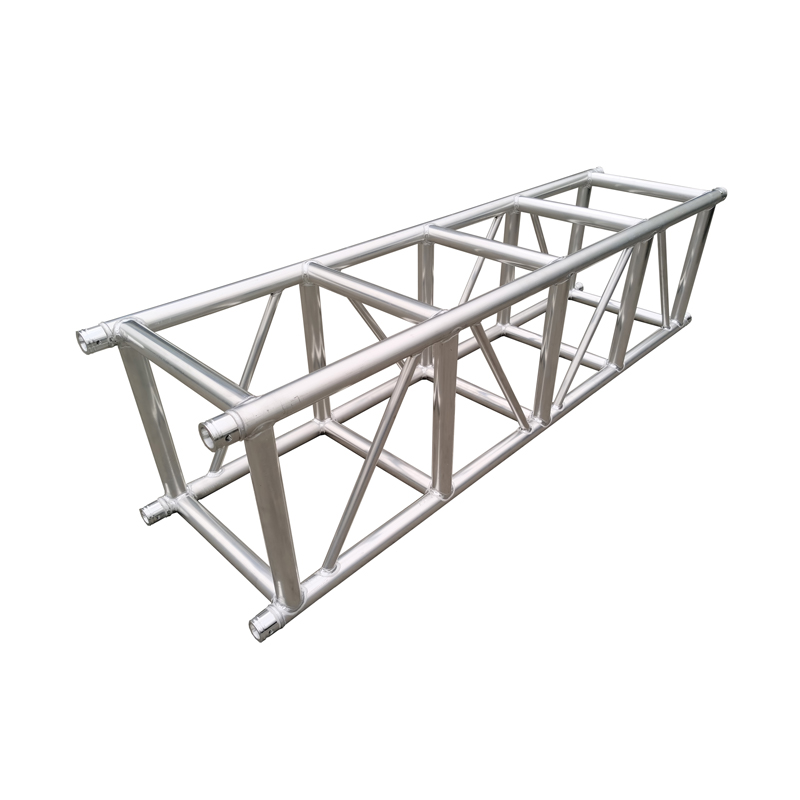
400×400mm aluminum spigot truss for concert stage lighting applications.
For projects involving larger spans or more demanding equipment arrangements, a larger structural section may need to be considered. GF-Truss also lists a 520×520mm High Load Capacity Aluminum Spigot Truss. Its product specifications identify a 50×3.0mm main tube, 50×2.0mm vice tubes, and 25×2.0mm brace tubes, with a recommended span of up to 16 meters.
For projects with more demanding structural requirements, the 520×760mm High Load Capacity Aluminum Alloy Spigot Truss is another product option listed in the GF-Truss range. Its larger rectangular cross-section can be considered when reviewing structural layouts that require a different truss geometry.
The following table summarizes several GF-Truss product options. These are product dimensions and specifications, not interchangeable load ratings.
| Truss Size | Product Configuration | Potential Application |
|---|---|---|
| 290×290mm | Aluminum Spigot Box Truss | Exhibitions and lighting displays |
| 400×400mm | V400 Spigot Truss | Medium to large concert lighting structures |
| 520×520mm | V520 Spigot Truss | Medium and large performance structures |
| 520×760mm | High Load Capacity Spigot Truss | Projects requiring larger structural sections |
The appropriate size should be determined using the manufacturer's load tables or engineering calculations for the exact model, span, support conditions, and loading arrangement.
Evaluate the Load Capacity and Span Requirements
Load capacity and unsupported span are two of the most important factors when selecting an aluminum lighting truss. A truss that performs adequately over a short span may not be suitable when the distance between supports increases.
The structural assessment should account for several types of loading:
- Dead load: The self-weight of the truss and permanently attached components.
- Equipment load: The combined weight of lighting fixtures, cables, clamps, brackets, and accessories.
- Point load: A concentrated load applied at a specific position, such as a heavy moving head fixture.
- Distributed load: Equipment weight spread across a section of the truss.
- Dynamic and environmental loads: Additional forces that may arise from movement, wind, or other operating conditions.
For example, consider a lighting beam carrying several moving head fixtures. Even if the total equipment weight appears manageable, placing the heaviest fixtures near the center of an unsupported span can produce a different bending response from distributing them closer to the supporting points.
Deflection also matters. Excessive deformation may affect fixture alignment, connected equipment, and the overall appearance of the stage lighting installation. Therefore, both strength and serviceability should be considered when evaluating a truss system.
GF-Truss publishes product-specific testing information for its 400×400mm spigot truss. The product page describes a 16-meter test sample subjected to different loading arrangements, including center-point, multi-point, and uniformly distributed loads. These test results apply to the documented test configuration and should not be interpreted as a universal working-load rating for every installation.
Understand the Difference Between Spigot Truss and Bolt Truss
Connection design influences assembly time, component compatibility, and the way a truss structure is configured. Spigot trusses and bolt trusses are two common connection options available for aluminum event structures.
Spigot Truss
Spigot trusses use connector pins and locking clips to join compatible sections. This connection arrangement supports modular assembly and is useful for event structures that need to be installed, dismantled, transported, and reused regularly.
Bolt Truss
Bolt trusses use mechanical bolted connections to join compatible sections. They may be selected for projects where the specified connection arrangement and structural design call for this fastening method.
The decision should not be based on the assumption that one connection type is always stronger. The performance of the complete truss depends on connector geometry, fastener specifications, joint design, fabrication quality, and the structural configuration.
GF-Truss offers both Aluminum Spigot Truss and Bolt Truss product categories. When purchasing additional sections for an existing lighting rig, confirm that the connector dimensions, pins, clips, and structural specifications match the original system. Similar external dimensions do not guarantee compatibility between different manufacturers.
Check Aluminum Alloy and Tube Specifications
Aluminum alloy selection is important, but the alloy grade alone does not determine the performance of a lighting truss. Tube diameter, wall thickness, brace arrangement, welding quality, and connection details must be evaluated together.
GF-Truss lists 6061-T6 and 6082-T6 aluminum alloy options for its 400×400mm spigot truss and 520×520mm spigot truss. These material specifications should be checked against the actual product configuration when requesting a quotation.
When comparing aluminum truss products, pay attention to the following details:
- Main tube dimensions: The primary chords are important structural members and should match the documented product specifications.
- Vice tube dimensions: These components contribute to the overall truss framework and structural behavior.
- Brace tube arrangement: The number, orientation, and dimensions of diagonal braces affect how loads are transferred through the structure.
- Welding quality: Weld consistency and fabrication accuracy influence connection integrity.
- Surface finish: Natural aluminum and optional black finishes may be considered according to visual and project requirements.
For example, GF-Truss specifies the 520×520mm V520 with 6061-T6/6082-T6 aluminum alloy options, a 50×3.0mm main tube, 50×2.0mm vice tubes, and 25×2.0mm brace tubes. Buyers should confirm the selected material and actual configuration before ordering.
Consider the Lighting Rig Layout and Mounting Accessories
A suitable truss must also work with the lighting equipment and rigging accessories used in the production. The mounting arrangement affects where loads are introduced into the structure and how efficiently the lighting team can complete installation.
Before installation, prepare a lighting plot showing the positions of fixtures, clamps, cable routes, and other suspended equipment. This makes it easier to identify concentrated loading areas and coordinate the truss layout with the lighting design.
Important mounting considerations include:
- Fixture compatibility: Check that the selected clamps and mounting accessories are suitable for the truss chord dimensions.
- Load distribution: Avoid unplanned concentrations of heavy fixtures and follow the approved rigging layout.
- Independent safety connections: Each suspended fixture should have an appropriate independent safety attachment as required by the applicable rigging procedures.
- Cable management: Secure cables properly and account for their weight when evaluating the overall loading arrangement.
- Access and maintenance: Allow sufficient clearance for focusing, adjustment, inspection, and equipment replacement.
> Important: Never drill, weld, or modify a truss to accommodate a lighting clamp without approval from the manufacturer or a qualified structural engineer. Use compatible accessories and follow the specified installation instructions.
Choose a Suitable Truss Configuration for Indoor and Outdoor Concerts
The installation environment affects the type of truss structure and support arrangement required. Indoor and outdoor concert lighting projects may use similar aluminum truss components, but their environmental loading and installation conditions can be very different.
Indoor Concert Lighting
Indoor installations commonly use venue-approved overhead rigging points, lighting grids, or ground-supported structures. Buyers should confirm the venue's rigging restrictions, available suspension points, permitted loads, and installation height before selecting the truss.
Outdoor Concert Lighting
Outdoor structures require additional consideration of wind exposure, rain, ground conditions, and weather-related operating limits. If lighting equipment is installed on a roof or exposed overhead structure, the complete system must be assessed for relevant environmental loads.
A truss suitable for an indoor lighting grid should not automatically be assumed suitable for an outdoor stage roof. The support system, bracing, anchoring, and environmental design must all match the actual application.
For larger event structures, GF-Truss also provides roof and tower system categories. These complete configurations should be evaluated separately from individual truss sections because the overall structural behavior depends on the arrangement of beams, towers, connections, and supports.
Inspect the Truss Before Installation and After Each Event
Regular inspection is essential for reusable concert lighting trusses. Repeated transportation, handling, assembly, and dismantling can cause damage that may not be immediately obvious.
Before installing a truss, inspect the following areas:
| Inspection Area | Items to Check |
|---|---|
| Main Tubes | Dents, bending, deformation, and visible damage. |
| Welded Joints | Cracks, separation, and unusual surface conditions. |
| Bracing Members | Bent braces, damaged connections, and missing members. |
| Connectors | Worn spigots, damaged pins, missing R-clips, and loose fittings. |
| Accessories | Clamps, brackets, safety attachments, and compatibility. |
Any truss section with suspected structural damage should be removed from service until it has been assessed by a qualified person. Do not attempt to repair damaged load-bearing members through unauthorized welding or straightening.
What Should You Ask an Aluminum Truss Manufacturer Before Buying?
Choosing a manufacturer is an important part of building a reliable concert lighting system. Beyond product appearance and quotation price, buyers should review the available technical documentation and confirm whether the proposed truss matches their actual project requirements.
Before placing an order, ask the supplier for:
- Detailed product drawings and cross-sectional dimensions.
- Aluminum alloy specifications and tube wall thickness.
- Load tables or test reports for the specific truss model.
- Connection details and compatible accessories.
- Available section lengths and customization options.
- Inspection records and relevant quality documentation.
- Transportation, storage, and installation recommendations.
> A reliable load assessment must match the exact truss model, span, support arrangement, and loading condition. A load figure taken from another size or configuration should never be used as a substitute.
GF-Truss offers aluminum spigot trusses, bolt trusses, custom-shaped trusses, and related structural systems for concert stages, exhibitions, and event applications. Providing the lighting plot, equipment list, required span, and installation environment allows the manufacturer to better understand the project and discuss an appropriate product configuration.
Frequently Asked Questions About Aluminum Trusses for Concert Stage Lighting
1. What size aluminum truss is suitable for concert stage lighting?
The appropriate size depends on the lighting equipment weight, unsupported span, support arrangement, and load distribution. GF-Truss offers 400×400mm and 520×520mm spigot trusses, among other options. The final selection should be verified using the corresponding product load data and structural calculations.
2. Is a larger aluminum truss always stronger?
Not necessarily. Cross-sectional dimensions are only one factor. Main tube thickness, brace configuration, aluminum alloy, welding quality, connections, and span conditions all affect structural performance. Compare product-specific technical data rather than relying on external dimensions alone.
3. What is the difference between 6061-T6 and 6082-T6 aluminum trusses?
Both are aluminum alloy options used in structural applications. Their mechanical properties and fabrication characteristics differ, so the selection should be based on the specific design requirements and manufacturer documentation. Alloy grade alone does not determine the safe working load of a truss.
4. How do you calculate the load capacity required for a lighting truss?
Start by listing the weight and position of every lighting fixture, cable, clamp, and accessory. Then evaluate the truss self-weight, span, support conditions, concentrated loads, distributed loads, and relevant dynamic or environmental forces. The final assessment should use manufacturer load tables and qualified engineering calculations.
5. Should I choose a spigot truss or a bolt truss for concert lighting?
Spigot trusses are often considered for modular event installations that require repeated assembly and dismantling. Bolt trusses use mechanical bolted connections and may suit other specified structural arrangements. The best option depends on the project design, connection requirements, and component compatibility.
6. Can the same aluminum lighting truss be used for indoor and outdoor concerts?
A truss section may be used in different environments if its material, condition, structural configuration, and installation method are suitable. However, outdoor applications require additional evaluation of wind, weather, ground conditions, and anchoring or support arrangements. Indoor approval does not automatically establish outdoor suitability.
Choose the Right Concert Stage Lighting Truss with GF-Truss
Selecting an aluminum truss for concert stage lighting requires a complete understanding of equipment loads, span requirements, structural dimensions, connection methods, and installation conditions. The right choice is not necessarily the largest or most expensive truss, but the configuration that meets the project's actual engineering requirements.
GF-Truss provides aluminum spigot trusses, bolt trusses, and customized truss solutions in different dimensions for concert stages, lighting installations, exhibitions, and other event structures. Its product range includes 400×400mm and 520×520mm lighting trusses, as well as larger structural options for projects with different requirements.
Whether you are planning a touring concert lighting rig, an indoor stage structure, or a large outdoor event, preparing your equipment list, lighting layout, required span, and installation details is the best way to begin selecting a suitable truss system.
Contact GF-Truss to discuss your concert stage lighting project and explore aluminum truss configurations based on your specific requirements.
Website: www.gftrusses.com