A stage truss is far more than a simple aluminum frame. It is a critical aluminum truss structure engineered to withstand complex forces, including compression, tension, shear, and torsion. For event managers handling an event truss, and procurement officers, a superficial understanding of truss components is a liability. This comprehensive guide provides a deep-dive analysis into the anatomy of a stage truss, the physics of its components, and the engineering logic behind the truss system connection methods that hold your show together. To grasp the fundamental principles of these structures, we recommend starting with our foundational guide: What Is A Stage Truss System and How Does It Work?
What Defines a Professional Aluminum Truss Structure?
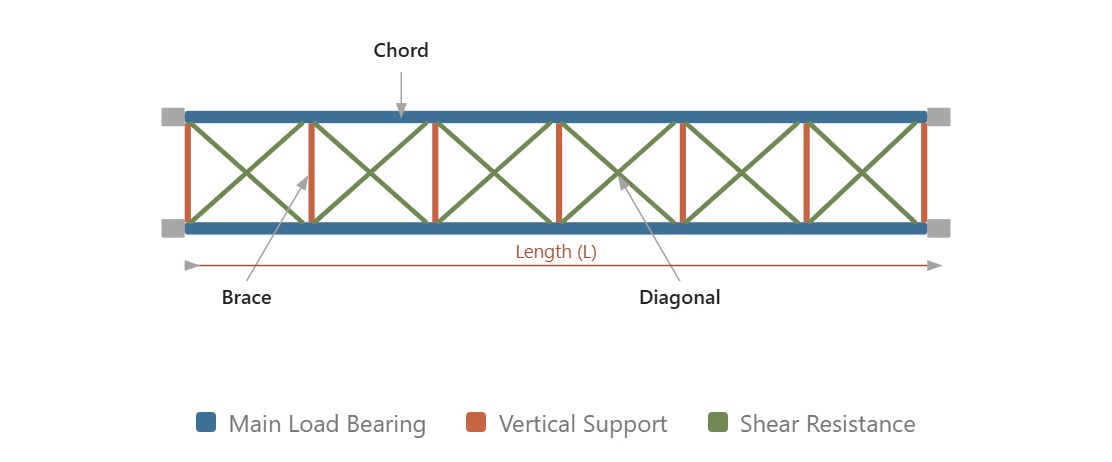
A professional-grade stage truss is a modular structural framework primarily composed of four distinct engineering elements: Chords (the longitudinal members), Braces (the vertical support tubes), Diagonals (the triangulated shear-resisting lattice), and a Connection Interface (either Bolt-plate or Spigot-conical).
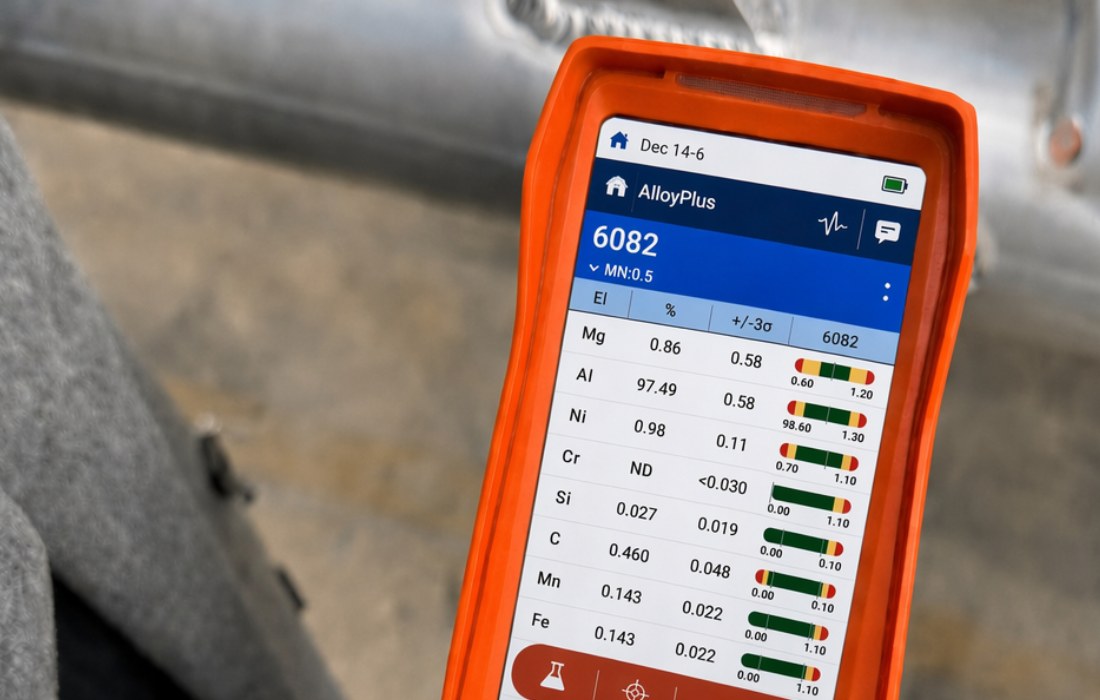
These components are precision-welded from high-tensile 6082-T6 aluminum alloy. The structural integrity of the truss system is determined by the "triangulation" of these tubes, which allows the truss to dissipate localized stress across the entire span, preventing catastrophic structural failure under heavy point loads or distributed loads.
Aluminum Truss Chords: Load Capacity and Technical Specifications
The truss chords (also known as the main tubes) are the four longitudinal members that form the edges of the truss. In engineering terms, they act as the "outer fibers" of a beam. Whether it is a standard square unit or a complex aluminum roof truss, the chords bear the brunt of the pressure.
Load Management: When a truss system carries a downward load at mid-span, bending forces are generated within the structure. The top chords primarily resist compression, while the bottom chords carry tension forces. This load distribution allows the truss to achieve high strength while maintaining a lightweight design. The truss chords must have sufficient wall thickness to resist "local buckling", where the tube wall physically crumples under pressure.
Detailed Specifications: Standard concert-grade square truss (e.g., 290mm or 400mm series) typically utilizes 50mm (2 inch) diameter tubes with a 3mm wall thickness. When planning a truss and lighting setup, the precise dimensions of your chords will dictate your load limits; for a deep dive into industry-standard widths, check out How Wide is A Lighting Truss? The Ultimate Guide to Choose Lighting Truss.
Surface Integrity: Any dent, scratch, or "nick" deeper than 10% of the chord's wall thickness is a grounds for immediate decommissioning. Such damage creates a "stress riser" where a crack can propagate, leading to sudden failure.
Aluminum Truss Bracing and Diagonals: The Logic of Triangulation
If the chords are the spine, the bracing and diagonals are the ribs and muscles that keep the truss structure from deforming.
Vertical Braces: These tubes are welded perpendicular to the chords. Their primary role is to maintain the square or triangular cross-section of the truss. They ensure that all four chords work in unison rather than acting as four independent, flexible tubes.
Diagonals: This is the most misunderstood component. Diagonal tubes are responsible for handling shear forces. In a high-load aluminum lighting truss, these diagonals are vital for maintaining stability when moving heads are attached. As a load travels across the truss, the diagonals transfer that energy from the chords to the supports.
Welding Patterns: In high-quality manufacturing, the diagonals are positioned to create a continuous "N-pattern" or "W-pattern" of triangles. Because a triangle is the only geometric shape that cannot be deformed without changing the length of its sides, this pattern creates an incredibly rigid "web" that prevents the truss from twisting (torsion) under off-center loads, such as a heavy LED screen hanging slightly to one side.
Bolt Truss Connection: High-Tensile Rigidity for Heavy Loads
The Bolt system is the "old guard" of the industry, favored for its extreme robustness in fixed installations and super-heavy engineering projects.
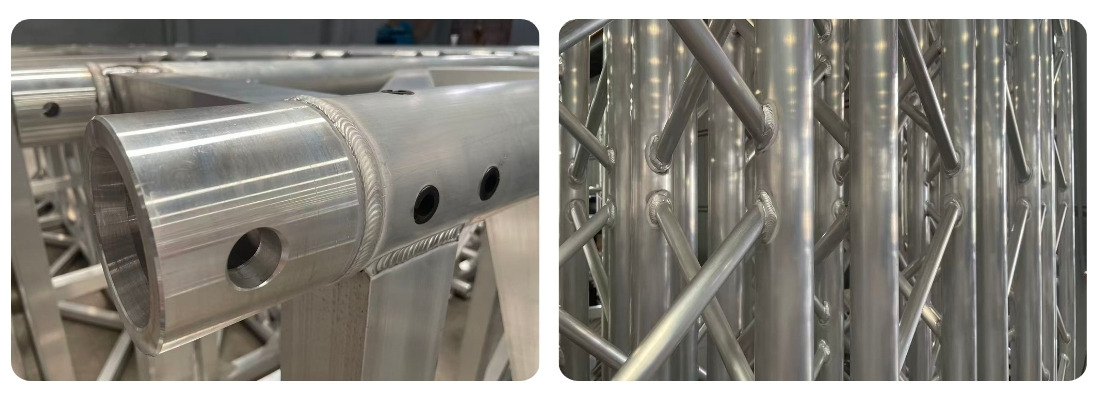
End Plates: Bolt trusses feature 8mm to 10mm thick aluminum end plates welded to the chords. The precision of the welding bead here is the single most important factor. We utilize high-skill manual TIG welding to ensure "root penetration", so the chord become a single molecular piece of aluminum.
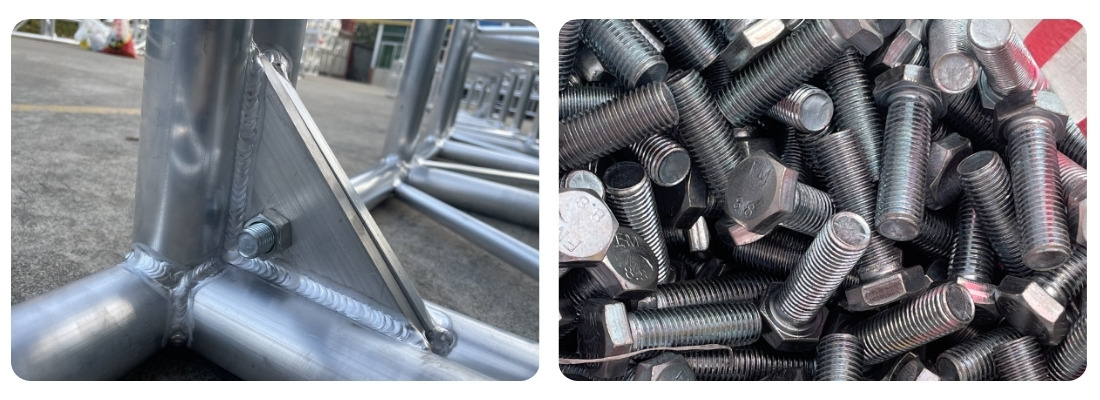
Fastener Accessories: The connection is only as strong as the bolt. Professional systems require Grade 8.8 or 10.9 High-Tensile Steel Bolts. They are rated for specific "Shear" and "Tensile" limits.
Vibration Safeguards: Stage truss is often subjected to low-frequency vibrations from subwoofers. This energy can cause standard nuts to vibrate loose. Professional Bolt systems must use nuts, washers and spring washers to provide constant outward pressure on the threads, ensuring the nut stays locked in place for the duration of a long show tour.
Spigot Truss System: Precision at Speed
The Spigot system has become the global rental standard due to its "zero-play" connection.
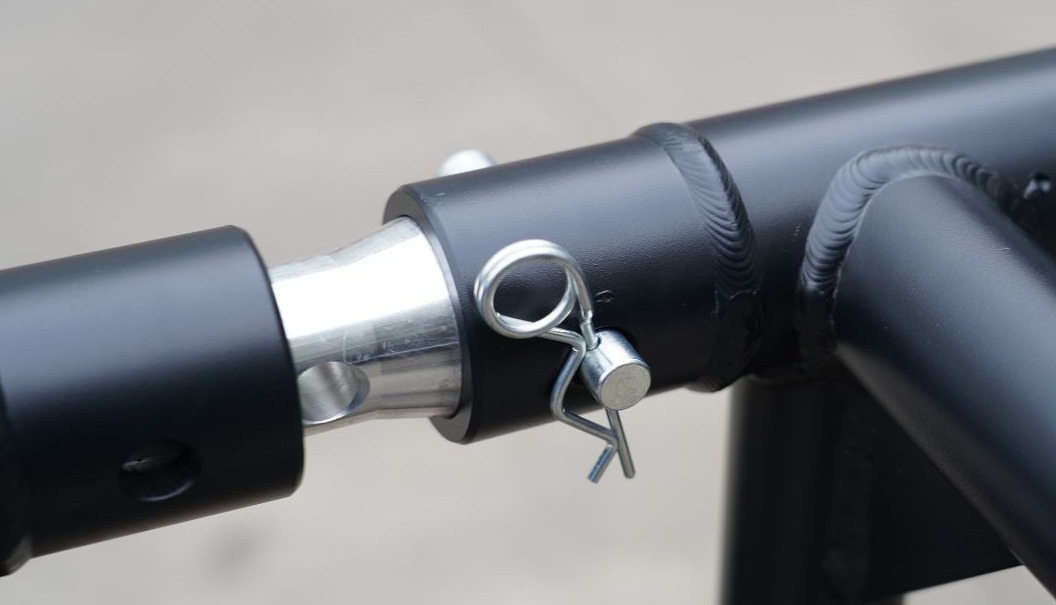
Couplers: This is a solid aluminum insert with a tapered conical shape. The taper is the key: as the pin is driven into the hole, the two truss sections are pulled together with immense force. This creates a force-fit connection that feels like a single continuous piece of metal, whereas older bolt systems cannot sometimes perfectly flush.
Pins: The pins must be tapered to match the coupler's internal bore exactly. A common sign of a low-quality truss is ovalized pin holes, which can occur when the material is too soft or the connection fit is not precise.
R-Clips: In a spigot truss system, the R-clip is the insurance policy. While the friction of the tapered pin handles the load, the R-clip prevents the pin from ever sliding out due to accidental knocks or intense vibrations. In professional rigging, a missing R-clip is considered a major safety violation.
6082-T6 vs. 6061-T6 Aluminum: Which is Best for Stage Trussing?
While some market often uses 6061, the international touring standard (and our preferred material) is 6082-T6. This choice is critical because it offers significantly higher ultimate tensile strength.
Chemical Composition: 6082 contains higher levels of Manganese and Silicon. This structural difference makes it much more resistant to "localized stress" and gives it a higher Ultimate Tensile Strength (UTS).
Heat Affected Zone: Aluminum loses strength when welded. 6082-T6 can recover much of its structural performance after the welding process through appropriate heat treatment. As a result, welded joints on aluminum trusses can maintain strength comparable to the tubes themselves.
T6 Tempering: T6 isn't just a label, and it’s a multi-stage heat treatment process involving solution heat treatment and artificial aging. This process is what transforms soft aluminum into a structural material capable of supporting tons of equipment.
Summary: Key Technical Takeaways
l Geometric Stability: The diagonal lacing is the most critical component for preventing shear failure and torsion.
l Material Superiority: 6082-T6 aluminum provides a significantly higher yield strength than other materials for truss structure manufacturing.
l Connection Physics: Bolt systems prioritize rigid behavior for long spans, while Spigot systems prioritize speed and precision.
l Hardware Fail-Safes: Safety is not just in the tubes but in the fasteners. Using anything less than Grade 8.8 steel bolts or hardened alloy steel pins is a violation of international rigging safety standards.
FAQ
Q: Why do I see small cracks around the weld joints of my diagonals?
A: These are "stress cracks" and are an indicator of fatigue failure. Aluminum has a finite fatigue life. If a truss has been overloaded or subjected to years of heavy touring, the welds will eventually fail. Any visible crack, no matter how small, means the truss section must be destroyed and replaced immediately.
Q: What is "Deflection" and how much is acceptable?
A: Deflection is the "bend" or "sag" in a truss span under load. Every truss has a calculated limit (usually L/100 or L/150). If your truss has reached its deflection limit, it doesn't mean it will snap immediately, but it does mean it is no longer behaving as a predictable beam and you are entering the "danger zone."
Q: How does wind load affect the components of my outdoor truss?
A: Wind load can create additional stress on outdoor truss components, especially the main chords, braces, and connections. A properly designed system with suitable bracing helps maintain stability and safety in outdoor environments.