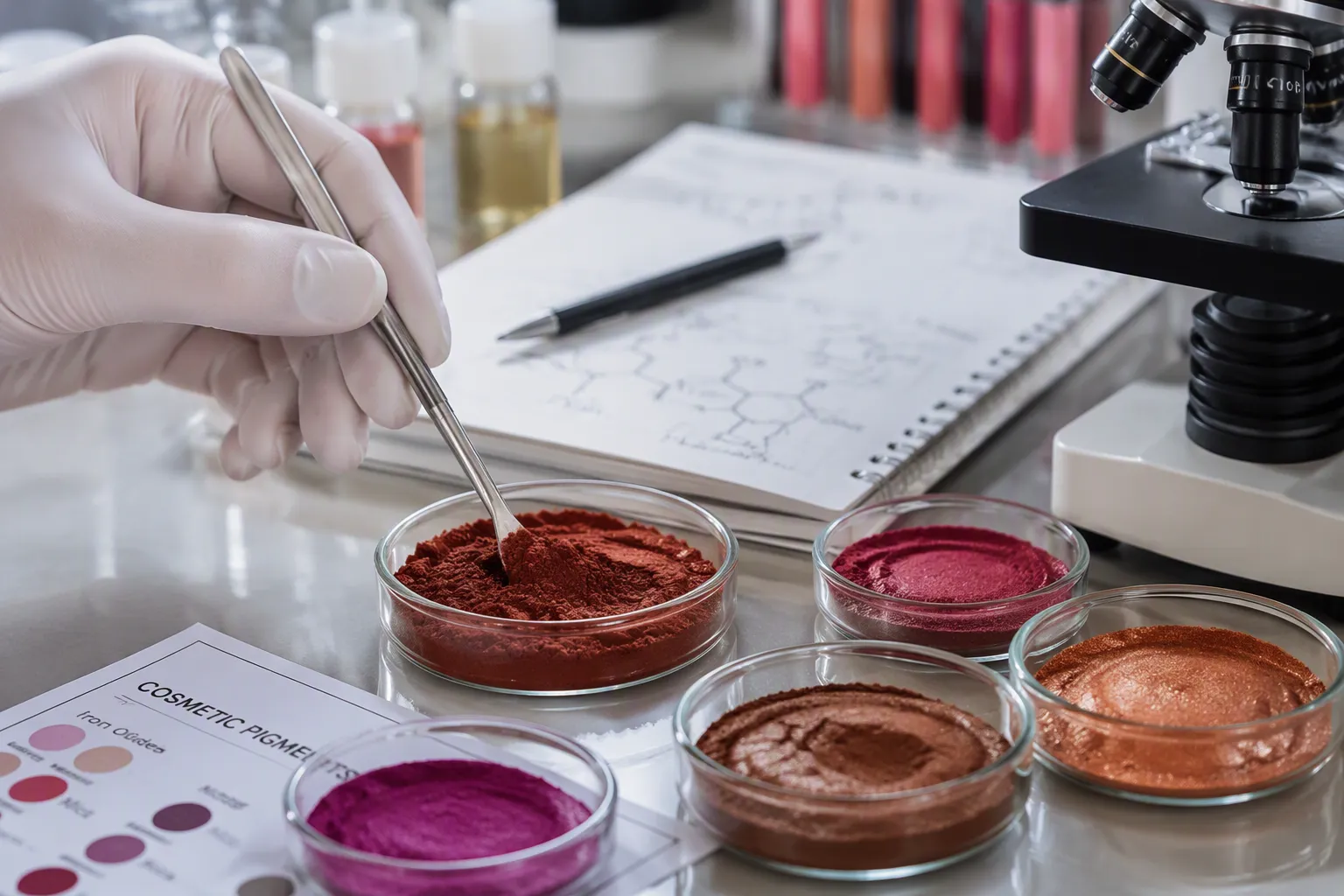
You choose surface treated pigments by matching the treatment to your formulation goals. First, define your system: emulsion, anhydrous, or surface treated pigment powder. Next, set your top priority: dispersibility, stability, skin feel, or cost. These two answers narrow the field before you test a single sample.
Key Takeaways
-
Start by defining your formulation system and top priority. This narrows your treatment options before testing.
-
Match your treatment to your formulation type, desired skin feel, and regulatory limits for best results.
-
Always test small batches with your actual formula to verify dispersion, stability, and wear performance.
What Surface Treatments Do

Why Untreated Pigments Fall Short
Untreated pigments create real formulation challenges. They lack the surface chemistry needed to integrate smoothly into your base. You often see color fading from UV exposure. pH changes can shift the pigment's shade unexpectedly. You struggle with uneven dispersion and particle settling. In powders, untreated pigments fail to bind well, leaving a chalky finish. Oxidative degradation from air and trace metals further shortens your product's stability. These issues make it difficult to achieve a consistent, high-performing cosmetic without extensive process adjustments.
How Coatings Change Performance
A surface treatment acts as a molecular bridge. It modifies the pigment's surface energy to match your formulation base. A hydrophobic coating, like silica or silicone, makes a pigment wet out perfectly in oils. This matching process, called binder compatibility, keeps particles separated and prevents flocculation. Silicone coatings, like those from Kolortek, transform performance. They boost water resistance, increase the longevity of sun protection products, and minimize the whitening effect often seen with untreated mineral filters. The coating simply improves how the pigment interacts with everything else in your formula.
The Main Benefit Categories
The right treatment delivers a cascade of benefits. You can categorize these improvements to match your top priority. For instance, if your goal is a silky, long-wearing powder, you prioritize sensory and skin adhesion benefits.
|
Category |
Benefit |
|---|---|
|
Dispersion & Formulation |
Improved dispersibility in oil; reduced mixing energy |
|
Sensory Feel |
Enhanced slip, smooth and light texture on skin |
|
Surface Properties |
Increased hydrophobicity and water resistance |
|
Performance on Skin |
Increased skin adhesion; long wear |
|
Durability & Stability |
Improved photostability and oxidation resistance |
|
Hybrid Treatments |
Combine multiple functionalities in one product |
Kolortek offers a range of skin-friendly surface treated pigment powder designed to elevate optical properties and texture, giving you the exact benefit profile your project demands.
Key Selection Factors
Your formulation system sets the boundaries for every treatment decision. A treatment that performs brilliantly in a solvent-based system may fail completely in a water-based emulsion. You need to evaluate three core factors before you commit to a sample: formulation type and compatibility, sensory profile and particle size, and regulatory, safety, and cost limits. Each factor interacts with the others. A change in one area often forces a reassessment of the remaining two.
Formulation Type and Compatibility
The chemical environment of your formulation determines which surface treatments will actually work. In powder coatings, a silica matrix treatment provides broad compatibility with most powder resin chemistries. Polymer encapsulation is preferred for acrylic powder coatings. Both approaches improve spray efficiency and bonding efficiency while enhancing chemical and humidity stability. In radiation-cure coatings, untreated metallic pigments are limited to two-pack systems where the pigment is isolated from the monomer. Surface-treated versions using modified silica encapsulation enable one-pack stability and are supplied as low- or zero-VOC pigments with excellent compatibility.
The table below maps formulation types to recommended treatments and their rationale.
|
Formulation Type |
Recommended Pigment Surface Treatment |
Rationale |
|---|---|---|
|
Architectural interior (flat/matte) paints |
Porous, high oil-absorption treatments |
Maximizes dry hiding by spacing particles apart and preventing crowding at high PVC |
|
Architectural exterior paints |
Dense silica or zirconia treatments (Rutile grade) |
Enhances UV/weather durability, chalk resistance, and gloss retention; high oil-absorption grades are avoided because they lower gloss and absorb binder |
|
Industrial & automotive coatings |
Hydrophobic organic treatments plus dense silica encapsulation (fine-particle Rutile) |
Improves dispersion in solvent-based systems, allows high pigment loading without viscosity loss, and yields high DOI/gloss |
|
Powder coatings |
Specific treatments for free-flow and heat/overbake stability |
Prevents yellowing during high-heat curing and keeps powder free-flowing without clumping |
|
Silica matrix treatment or polymer encapsulation |
Provides compatibility with powder resin chemistries (polymer encapsulation especially for acrylics) and improves spray/bonding efficiency and humidity stability |
|
|
Metallic pigments in radiation-cure coatings |
Silica encapsulation modification |
Enables one-pack stability by isolating the pigment from reactive monomers |
You can group treatment chemistries into two broad families. Inorganic treatments act as a barrier layer. Silica (SiO₂) increases durability and abrasion resistance. Dense silica forms a tight, non-porous shell for super durable automotive and aerospace grades. Porous or fluffy silica acts as a physical spacer for flat paints to improve dry hiding. Alumina (Al₂O₃) improves dispersion and processability by helping the pigment wet out faster and ensuring resin compatibility. Zirconia (ZrO₂) enhances gloss retention and weather resistance, often combined with silica or alumina for high-performance exterior and industrial coatings.
Organic treatments serve as compatibilizers and flow enhancers. They control dust for cleaner, safer manufacturing. They prevent bridging and ratholing in storage hoppers for consistent dosing. They accelerate wetting. Hydrophobic organic treatments are essential for plastics and solvent-based paints to ensure immediate pigment wet-out and reduced cycle times.
For cosmetic emulsions, you need treatments that match the polarity of your oil phase. Silicone coatings, such as methicone or dimethicone, work well in anhydrous and water-in-oil systems. They provide hydrophobicity and improve wear. For oil-in-water emulsions, you may need a more hydrophilic treatment or a hybrid coating that balances both phases. Kolortek supplies surface treated pigment powder grades with treatment profiles designed for these specific system requirements.
Sensory Profile and Particle Size
Particle size drives both optical performance and tactile experience. You cannot separate the two. A pigment that delivers brilliant color but feels gritty will fail in a pressed powder or lipstick. The relationship between particle size and skin feel follows a predictable pattern.
|
Particle Size (μm) |
Luster Quality |
Skin Feel |
Application Suitability |
|---|---|---|---|
|
5–25 |
Fine luster |
Silky smooth |
Lipstick, pressed powders, offset printing inks |
Pressed powders and lipsticks typically use 5–25 μm grades for fine luster without graininess.
Larger particles deliver more sparkle and flash, but they can feel rough on the skin. Smaller particles provide a softer, more cushiony feel, but they may scatter light differently and reduce the intensity of the color payoff. You need to match the particle size distribution to your sensory target. A body shimmer product can tolerate larger particles for dramatic effect. A daily-wear face powder demands a tighter distribution in the 5–25 μm range for a smooth, elegant finish.
The surface treatment itself also modifies skin feel. Silicone treatments add slip and a silky texture. Fatty acid treatments can impart a creamier, more emollient feel. Ester treatments often provide a light, dry touch. You should evaluate the treated pigment in your actual base, not just as a powder. The interaction between the treatment, the particle size, and the surrounding medium determines the final sensory result.
Regulatory, Safety, and Cost Limits
Cosmetic colorants face strict regulatory control across every major market. Purity, heavy metal limits, permitted-use conditions, and batch certification requirements act as major purchasing criteria, especially in the United States and Europe. The U.S. FDA requires approval for every color additive before use in cosmetics, with the exception of coal tar hair dyes. Across the U.S., EU, China, and other markets, pigments must comply with different color additive lists, permitted-use conditions, purity limits, and labeling rules. These differences increase testing, documentation, and registration costs for suppliers.
You must verify several specific regulatory points before you select a treated pigment.
-
The FDA requires each cosmetic color additive to be permitted for its specific intended use. Many colors allowed for general use are not permitted in the eye area.
-
The EU maintains allowed colorants and conditions through Annex IV of its Cosmetics Regulation. Regional use mapping is a core commercial capability for any supplier.
-
Pigment suppliers should map every grade to lip, eye, nail, face, or skin-care tint use by jurisdiction rather than labeling it broadly for cosmetics.
-
Brands need to verify underlying evidence for vegan or cruelty-free claims instead of treating a sales descriptor as complete substantiation.
-
Contract manufacturers can reduce reformulation by approving backup shades with comparable regulatory and surface-treatment profiles.
-
Distributors should preserve batch certificates and change notifications because a minor composition or treatment change can trigger a new product assessment.
Market data reveals how regulatory positions distribute across the industry. EU-compliant grades represent 27% of the regulatory-position mix, while FDA-accepted grades hold 23%. Heavy-metal controlled products account for 20%, showing that impurity evidence remains a substantial procurement criterion alongside legal listing status. Vegan and cruelty-free claims and global harmonized grades each hold 15%, but neither category removes the need for product- and jurisdiction-specific review.
The EU Cosmetics Regulation 1223/2009's Annex IV approved colorant list restricts cosmetic color additives to those specifically evaluated and authorized for cosmetic use in EU markets. This creates a regulatory compliance environment that parallels the U.S. FDA positive list system and sustains European cosmetic pigment supplier relationships with manufacturers certified to EU regulatory standards.
Introducing a new cosmetic pigment colorant to regulated markets requires navigating the EU Cosmetics Regulation Annex IV approval process, U.S. FDA new color additive petition procedures, and equivalent national regulatory review processes across China, Japan, South Korea, and ASEAN markets. Each of these markets maintains its own positive-list approval system. The cumulative cost of regulatory submissions, safety evaluation data generation, and approval timeline uncertainty across multiple jurisdictions creates multi-year, multi-million dollar investment requirements. These costs restrict new cosmetic colorant introduction to well-resourced specialty chemical companies.
U.S. FDA color cosmetics pigment regulations under 21 CFR Parts 73 and 74 maintain one of the world's most prescriptive positive list systems. They specify exactly which color additives are approved for cosmetic use and the conditions under which each is permitted. This creates a compliance-intensive procurement environment that sustains premium supplier relationships with pigment manufacturers whose regulatory documentation capabilities and purity specification consistency satisfy FDA compliance evidence requirements.
Cost considerations extend beyond the pigment's purchase price. A cheaper untreated pigment may require more dispersant, longer milling times, and higher processing energy. A treated pigment that costs more per kilogram can reduce your total formulation cost by simplifying your process and improving batch-to-batch consistency. You should calculate the true cost of use, not just the invoice price. Kolortek offers skin-friendly surface treated pigments that balance regulatory compliance with cost-effective performance across a range of applications.
Treatment Types and Performance Testing
You now understand what surface treatments do and which selection factors matter most. The next step is matching specific treatment chemistries to your formulation. Each treatment family offers distinct performance characteristics. You need to evaluate them against your system type, sensory target, and regulatory requirements. This section walks you through the major treatment categories and shows you how to test them properly.
Silicones and Silanes
Silicone and silane treatments dominate the cosmetic pigment market for good reason. They deliver reliable hydrophobicity, excellent skin feel, and broad compatibility with common cosmetic oils and silicones. You will find these treatments in foundations, pressed powders, BB creams, and hot pour formulas.
Methicone-treated pigments provide hydrophobic properties that improve slip and wetting. They enhance overall pigment performance in oils and silicones. Formulators recommend methicone treatments for foundations, BB creams, pressed powders, and hot pours. Dimethicone-treated pigments offer similar benefits. In pigmented powdered products, dimethicone treatments provide good hydrophobic properties that improve wear, enhance powder flow, help produce smoother powders, and increase color development. These characteristics support durability, application smoothness, and color intensity in foundation formulations.
Silane treatments work through a different mechanism. The AS treatment coats pigments with an alkyl-functional silsesquioxane, forming a hydrophobic surface. This hydrophobic coating improves dispersion in natural and synthetic oils and stabilizes particles in emulsions. You also get reduced oil absorption and improved wear on skin. Triethoxycaprylylsilane (11S) represents another common silane option. It offers moderate hydrophobicity with good dispersion properties.
Fluorinated treatments take performance further. Perfluorohexylethyl triethoxysilane (FS) creates a surface that is both hydrophobic and lipophobic. This dual repellency contributes to long wear and transfer resistance. You would choose fluorinated treatments for products that need extreme durability, such as long-wear lipsticks or transfer-proof foundations.
The table below summarizes the key silicone and silane treatments and their primary benefits.
|
Treatment |
Chemistry |
Hydrophobicity Level |
Primary Benefit |
Best Application |
|---|---|---|---|---|
|
Methicone (MS) |
Silicone |
High |
Slip, wetting, wear |
Foundations, pressed powders |
|
Dimethicone (DS) |
Silicone |
High |
Powder flow, color development |
Foundations, hot pours |
|
Triethoxycaprylylsilane (11S) |
Silane |
Moderate |
Dispersion, stability |
Emulsions, anhydrous systems |
|
AS Treatment |
Alkyl-functional silsesquioxane |
High |
Oil dispersion, reduced oil absorption |
Natural and synthetic oil systems |
|
FS Treatment |
Fluorinated silane |
Very High |
Long wear, transfer resistance |
Long-wear lipsticks, transfer-proof products |
Kolortek offers surface treated pigment powder with methicone, dimethicone, and other silicone-based coatings. These grades deliver the slip, wear, and color development your foundation and powder products demand.
Fatty Acids and Esters
Fatty acid and ester treatments offer an alternative to silicone chemistry. They work particularly well in systems where you want a creamier feel or where silicone compatibility is not ideal. These treatments also tend to cost less than specialty silicone options.
Lipophilic treatments include ITT (Isopropyl Titanium Triisostearate) and ASI (ITT with Amino Acid). Both are hydrophobic and lipophilic. They disperse easily in oils and provide a smooth, emollient feel. You would select ITT or ASI for lipsticks, cream foundations, and anhydrous systems where oil compatibility is critical. The amino acid modification in ASI adds a skin-friendly aspect that some formulators prefer for sensitive skin products.
Hydrogenated Lecithin (HLC) represents another fatty acid-derived option. This natural hydrophobic coating delivers a silky texture and long wear. It offers high compatibility with oils. You can use HLC in lip products, cream blushes, and any formula where you want a natural-derived treatment with proven performance.
The sensory profile of fatty acid and ester treatments differs from silicones. Silicones add slip and a dry, silky feel. Fatty acid treatments impart a creamier, more emollient touch. Ester treatments often provide a light, dry feel. Your choice depends on the sensory experience you want to create. A matte foundation might benefit from a silicone treatment for its dry slip. A nourishing lipstick might perform better with a fatty acid treatment that adds creaminess.
Natural Treatments and Surface Treated Pigment Powder
Consumer demand for natural and clean beauty products continues to grow. You can now choose from several natural surface treatments that meet this demand without sacrificing performance. These treatments carry certifications like COSMOS and appeal to brands positioning themselves in the natural segment.
Phytic Acid (PHY) offers a hydrophilic treatment option. It disperses easily in the water phase and produces low viscosity. You would select PHY for oil-in-water emulsions where you need the pigment to integrate smoothly into the aqueous phase. This treatment suits liquid foundations, tinted moisturizers, and other water-based color cosmetics.
Aloe (ALOE) provides a 100% natural hydrophobic treatment. It disperses easily and offers soothing properties. Aloe-treated pigments support high pigment loads and remain compatible with hot processes. You can use aloe-treated pigments in anhydrous systems, emulsions, and powder products where you want a natural story backed by solid performance.
Botanical Avocado (BA) delivers a hydrophobic treatment with a lightweight feel. It provides water resistance and supports high pigment loads. Botanical Avocado holds COSMOS certification, making it suitable for certified organic and natural cosmetic lines. This treatment works well in sunscreens, tinted moisturizers, and long-wear natural foundations.
These natural treatments expand your options for clean beauty formulations. They prove that you do not have to sacrifice performance for natural positioning. Kolortek supplies surface treated pigment powder grades with natural treatment options that meet COSMOS standards and deliver reliable results.
Testing Dispersibility, Stability, and Skin Feel
You have selected a treatment type that matches your formulation goals. Now you must verify that it performs as expected in your actual system. Testing separates promising candidates from production-ready pigments. You need to evaluate dispersibility, stability, and skin feel before you commit to a full-scale production run.
Dispersibility testing reveals how well the pigment integrates into your base. Visual inspection checks for uniformity, streaks, clumps, or separation in every batch. You should examine samples under proper lighting and note any inconsistencies. Particle size analysis measures the particle size distribution. The standard target is 90% of particles below 2 microns. Viscosity testing evaluates flow properties and consistency. Stable readings within your specification range indicate good dispersion. Accelerated aging simulates long-term storage conditions. You expose samples to elevated temperature, light, and humidity to predict settling, clumping, or color fading.
Stability testing follows a structured protocol. You store samples at 104°F and 75% relative humidity. You test at 0, 3, and 6 months. Microbiological assessments accompany these checks. You also examine packaging for light and oxygen protection. Freeze/thaw cycles provide another stress test. You freeze samples for 24 hours, then thaw them for 24 hours. This cycle tests emulsion durability under real-world shipping and storage conditions.
Wear performance evaluation connects your lab results to consumer expectations. You apply the formulation to skin or models. You monitor color integrity every two hours under heat and humidity. You assess transfer resistance and sebum/sweat resistance. Consumers expect 8 to 10 hours of consistent wear from long-wear products. Your testing must confirm that your formula meets this expectation.
Lab-based pigment evaluation ensures color intensity and batch accuracy. Spectrophotometry verifies that each batch matches your color standard. You also test purity, particle size, and batch consistency. Impurity checks confirm that your pigment meets regulatory limits.
The table below outlines the key tests and their purposes.
|
Test Type |
Method |
What It Measures |
Target Standard |
|---|---|---|---|
|
Visual inspection |
Lighted examination |
Uniformity, streaks, clumps |
No visible defects |
|
Particle size analysis |
Laser diffraction |
Particle size distribution |
90% < 2 microns |
|
Viscosity testing |
Rheometer |
Flow properties |
Within specification range |
|
Accelerated aging |
104°F / 75% RH storage |
Settling, clumping, fading |
No change at 6 months |
|
Freeze/thaw cycles |
24h freeze + 24h thaw |
Emulsion durability |
Stable after 3 cycles |
|
Wear testing |
Skin application |
Color integrity, transfer |
8–10 hours consistent wear |
|
Spectrophotometry |
Color measurement |
Batch accuracy |
Matches standard |
You should also benchmark against competitors through side-by-side testing. Environmental exposure tests for water, oil, and sweat confirm long-wear or waterproof claims. Consumer feedback on color fading or shifting provides real-world validation. Regulatory compliance review ensures your pigment meets FDA and EU requirements.
The Colour Index can serve as an initial reference, but it should not be the sole basis for final pigment selection. Technical data sheets can help with preliminary screening, but final suitability should be verified in the actual resin and application system through dispersion trials, spray-out testing, baking evaluation, and weathering tests.
A Step-by-Step Decision Guide
You now have all the information needed to select the right surface treatment. This step-by-step guide walks you through the decision process from start to finish. Follow these steps in order to narrow your options and validate your choice.
-
Define the coating layer and its function. Determine whether the pigment is intended for electrocoat, primer surfacer, basecoat, or refinish coating. Each layer has different performance priorities. Electrocoats emphasize stability and protection. Basecoats emphasize color and weatherability.
-
Match the resin system and application process. Account for waterborne, solventborne, or high-solids systems. Consider curing temperature, baking time, and film-forming conditions. These factors affect pigment wetting, dispersion, and storage stability.
-
Evaluate weatherability and service environment. Assess exposure to UV radiation, temperature extremes, moisture, and chemicals. Select pigments with appropriate lightfastness and chemical stability for your intended use.
-
Assess color and appearance requirements. Consider shade accuracy, transparency, opacity, chroma, and interaction with effect pigments. Metallic and pearlescent finishes require special attention to particle size and treatment compatibility.
-
Ensure product quality and compliance. Verify batch-to-batch consistency, dispersion reliability, and conformity with industry regulations. Check that your pigment meets FDA, EU, and other regional requirements for your intended use category.
-
Verify through testing. Use the Colour Index only as an initial reference. Confirm suitability via dispersion trials, spray-out testing, baking evaluation, and weathering tests in your actual resin system.
-
Test small batches before scaling up. Produce a pilot batch using your selected treated pigment. Run the full battery of dispersibility, stability, and wear tests. Compare results against your specifications. Only proceed to full-scale production after your pilot batch meets all criteria.
-
Document and standardize. Record your test results, batch numbers, and supplier certificates. Establish a specification sheet for your approved pigment grade. This documentation supports regulatory compliance and ensures consistency across future production runs.
This systematic approach reduces rework and prevents costly formulation failures. You validate each decision before you commit to large-scale production. The right treatment improves dispersion, stability, and skin feel while reducing your total cost of use.
Kolortek offers a comprehensive range of skin-friendly surface treated pigments. Their portfolio includes Red Iron Oxide, Yellow Iron Oxide, Black Iron Oxide, Titanium Dioxide, Sericite (Mica), Talc, and Chromium Oxide Green. These surface treated pigment powder grades elevate optical properties, texture, and pigment payoff. You can rely on Kolortek to provide the treatment chemistry and regulatory documentation your formulation requires.
Match the treatment to your formulation goals, not the other way around. Consider system type, sensory target, compatibility, regulation, and cost. Test small batches before scaling up. The right treatment improves dispersion, stability, and skin feel while reducing rework. Kolortek offers skin-friendly surface treated pigment powder—including Red Iron Oxide, Yellow Iron Oxide, Black Iron Oxide, Titanium Dioxide, Sericite (Mica), Talc, and Chromium Oxide Green—to elevate optical properties, texture, and pigment payoff.
FAQ
What is the most common surface treatment for cosmetic pigments?
Silicone treatments, such as methicone and dimethicone, are the most common. They provide reliable hydrophobicity, excellent slip, and broad oil-phase compatibility.
How do I test whether a treated pigment works in my formulation?
You run small-scale dispersion trials in your actual base. Check particle size, viscosity, and stability under accelerated aging. Only scale up after your pilot batch meets all specifications.
Are there natural surface treatment options available?
Yes. Treatments like Phytic Acid, Aloe, and Botanical Avocado offer natural profiles. Kolortek supplies these options with COSMOS certification for clean beauty lines.