Styrene Ethylene Butylene Styrene (SEBS) block copolymers are among the most versatile thermoplastic elastomers (TPEs) on the market. Produced by the selective hydrogenation of Styrene-Butadiene-Styrene (SBS), SEBS uniquely combines the processability of thermoplastics with the elasticity of vulcanized rubber. It is widely applied across medical devices, wire/cable insulation, overmolding, automotive parts, sealants, and footwear.
However, not all SEBS grades perform identically. The molecular architecture—such as linear vs. star-shaped structures, vinyl content (1,2-structure), and main-chain monomer distribution—significantly dictates processability, oil absorption, transparency, and mechanical strength.
1. Linear vs. Radial SEBS
Standard SEBS usually has a styrene content of 30%–40%. In unfilled states, conventional SEBS exhibits low melt flow. To achieve melt processability, it is commonly extended with paraffin oil and modified with Polypropylene (PP).
- Linear SEBS (such as Sinopec YH-503T): Provides higher tensile strength and modulus due to more physical entanglement points along the linear polymer chains. It is the preferred choice for structural applications requiring higher tensile performance.
- Radial SEBS (such as Sinopec YH-602T): Features a multi-arm coupled structure with smaller relative arm molecular weight. This yields superior melt flowability, lower compression set, and better elasticity. It is ideal for high-elasticity applications like elastic bands, seal strips, and complex molded products.
2. High 1,2-Vinyl Content SEBS
Conventional SEBS requires heavy paraffin oil extension for processing. However, oil bleed-out, surface tackiness, and volatile organic compound (VOC) emissions under extreme high/low temperature conditions limit its application in clean or extreme environments.
By increasing the 1,2-structure content of the pre-hydrogenated polybutadiene segment (>60%): The chain regularity of the resulting SEBS is disrupted, which lowers melt viscosity.
- Direct Processing without Oil: Exhibit high melt flow rates without oil addition.
- Clean & Low-Odor Applications: Perfect for oil-free medical devices, surgical/protective clothing, film materials, automotive interior components, and transparent PP toughening agents.
3. Random Mid-Block Copolymerization
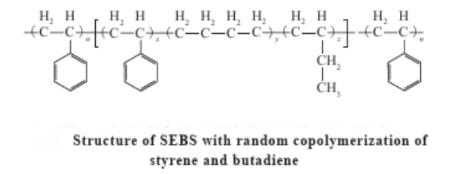
Introducing styrene randomly into the middle butadiene block creates a unique middle-chain random copolymer structure.
- Enhanced Transparency: The random dispersion of styrene interrupts polyethylene crystallization, yielding high optical clarity (light transmittance up to 88%).
- Filler Compatibility & Processing Aid: This structure increases polymer polarity, improving compatibility with inorganic fillers (CaCO3) and polar resins. When blended with standard SEBS, it acts as an effective processing promoter and surface quality enhancer.
- Damping Performance: Reduces elastic modulus and increases damping properties, making it suitable for shock-absorbing applications such as athletic tracks and suspended flooring mats.
4. Hydrogenated Styrene-Butadiene Random Copolymers
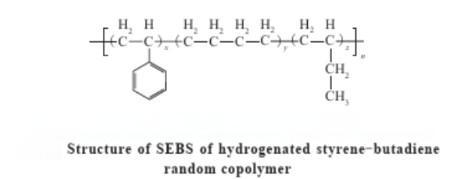
For modified EVA foaming applications (e.g., shoe soles, footwear midsoles), standard oil-extended SEBS often causes increased compression set and thermal shrinkage due to oil migration.
Hydrogenated styrene-butadiene random copolymers without terminal polystyrene block segments can be directly blended with EVA without oil extension:
- Improved Resilience & Low Shrinkage: Blending SEBS into EVA foam formulations significantly increases rebound resilience (up to 58%) while noticeably reducing compression set and thermal shrinkage.
- Dimensional Stability: Ensures lightweight, soft, and dimensionally stable foam products with excellent tactile feel.
Summary & Product Selection Matrix
| SEBS Structural Feature | Advantages | Applications |
| Linear Structure | High tensile strength, good mechanical integrity | Structural parts, high-strength TPE compounds |
| Radial Structure | High elasticity, low compression set, superior melt flow | Seal strips, elastic bands, complex injection molding |
| High 1,2-Vinyl Content | Processable without oil, zero oil bleed-out, low odor | Medical devices, transparent PP toughening, protective wear |
| Random Mid-Block Styrene | High transparency, high polar filler compatibility, damping | Clear TPEs, high-filler Masterbatches, vibration damping pads |
| Non-Block Hydrogenated Random Copolymer | Direct EVA blending without oil, high resilience, low shrinkage | Premium footwear midsoles, athletic shoe soles, foam mats |
Website: www.elephchem.com
whatsapp: (+)86 13851435272
E-mail: admin@elephchem.com