Aluminum Truss Systems: The Complete Guide to Types, Selection, and Safety
An aluminum truss system is a modular, load-bearing framework of aluminum alloy tubing and connectors. You gain high strength-to-weight ratio, corrosion resistance, fast assembly, reusability, and scalability. These benefits make aluminum truss the standard choice for temporary event structures. GF-Truss delivers certified, precision-engineered systems.
| Metric | Value |
| Global market size (2026) | 0.8–1.5 billion USD |
| CAGR (2026–2031) | 4.2%–6.8% |
Key Takeaways
· Aluminum truss systems offer high strength, low weight, and fast assembly for events.
· Always check load ratings and safety certifications to ensure a safe and reliable structure.
· Choose a supplier with technical expertise and certified products for peace of mind.
What Is an Aluminum Truss System?
Definition and Core Components
An aluminum truss system is a modular framework that you assemble from aluminum alloy tubing and connectors. You build it to carry loads such as lighting, audio, and video equipment. The core components include main tubes, inclined tubes, braces, and connection nodes. GF-Truss engineers each component for precise fit and reliable performance.
The alloy you choose shapes the system's strength and weight profile. The table below compares the two most common grades.
| Property | 6061-T6 | 6082-T6 |
| Density | Low | Low |
| Strength | High | Higher |
| Weight Efficiency | Excellent | Excellent |
| Corrosion Resistance | Good | Better |
| Weldability | Good | Moderate |
| Typical Use | General truss | Heavy-duty truss |
| Installation Efficiency | High | High |
You will find 6061-T6 in most lighting and stage truss because it balances strength and weldability. 6082-T6 suits large-span and roof systems that demand higher strength.
GF-Truss builds its systems to these exact specifications:
· F34 square box truss (290 mm): main tube 50×2 mm, Aluminum 6061-T6.
· CS20 spigot box truss (200×200 mm): main tube 30×2.0 mm, inclined tube 12×2.0 mm, braces 20×2.0 mm.
· BS4050 lighting truss (400×500 mm): main tube 50×3.0 mm, inclined tube 25×2.0 mm, braces 50×2.0 mm, Aluminum 6061-T6.
· BS50 outdoor bolt square truss (500×500 mm): main tube 50×3.0 mm, inclined tube 25×2.0 mm, braces 50×2.0 mm, Aluminum 6061-T6.
· BS40 roof screw lighting truss (400×400 mm): main tube 50×3.0 mm, inclined tube 25×2.0 mm, braces 50×2.0 mm, Aluminum 6061-T6.
Key Benefits for Event Production
You gain several advantages when you specify an aluminum truss system for your event. The material delivers a high strength-to-weight ratio, so you move and install structures with less effort. Aluminum resists corrosion, which extends service life across repeated indoor and outdoor use. Modular connections let you assemble and strike quickly. You also reuse the same components across different configurations and venues. GF-Truss supports this scalability with a full range of compatible parts.
Main Truss Types and Applications
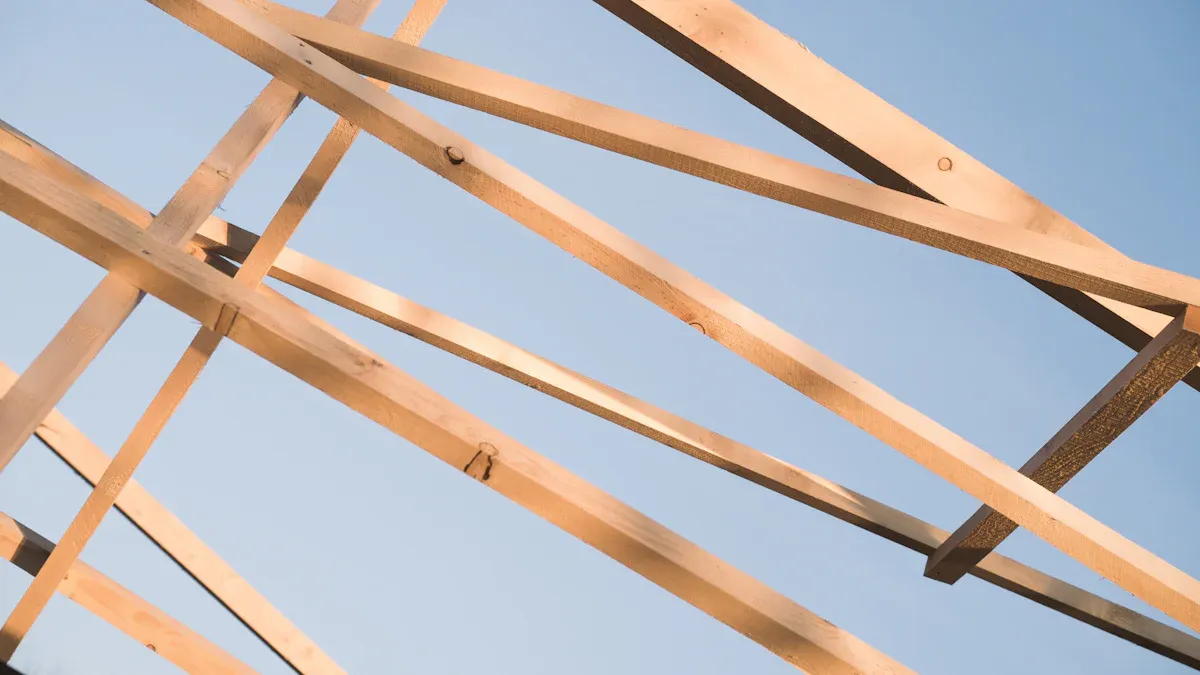
You will encounter three primary truss geometries in event production: box truss, triangle truss, and ladder truss. Each type solves a different structural problem. Your choice depends on load weight, span length, visual requirements, and the equipment you plan to hang. GF-Truss manufactures all three types with consistent connection standards, so you can mix them within a single aluminum truss system.
1. Box Truss
Box truss uses four chords arranged in a square or rectangular cross-section. This four-chord design delivers the highest stability among standard truss types. You will see box truss anchoring main spans, supporting LED walls, and carrying heavy-duty lighting systems. The closed square profile resists twisting and bending in multiple directions, which makes it the default choice for critical load paths.
Truss model names usually indicate the cross-section size. An F34/290 truss measures about 290 mm square and uses 50 mm main tubes with 20 mm braces in 6082-T6 aluminum. GF-Truss builds its F34 square box truss to these exact specifications with 6061-T6 main tubes at 50×2 mm. You can join standard sections to create longer spans and complex shapes. Common sectional lengths include 1 ft, 5 ft, 8 ft, and 10 ft.
Width selection drives both capacity and application fit. The table below summarizes typical use cases by truss width.
| Truss Width | Best For |
| 8"–12" | Retail displays, wedding lighting, indoor events and exhibitions with light loads |
| 16" | Small concerts and conferences |
| 20.5"–24" | Large exhibitions, stadium setups, large LED walls, heavy equipment |
The 12"×12" box truss is the most common size in film, live events, and small-to-medium structure builds. You use it for softboxes, stage lighting, overhead flyswatters, and small-to-medium platforms. The 20.5"×20.5" box truss offers higher strength and load capacity for heavy loads, larger spans, bigger rigs, large softboxes, heavy lighting positions, truss-off-truss builds, and beefy platforms. A 5-chord variant adds a fifth chord and thicker tube walls for long spans and heavy loads at large festivals, wide overhead runs, and truss roof systems.
Load ratings change with span length, load placement, and movement. Published ratings already include truss weight. The same truss holds more as a uniform distributed load (UDL) than as a single point load. Moving, swaying, and wind loads raise the force on the truss, so dynamic conditions require additional calculation. Longer unsupported spans lower safe capacity. Loads are not additive across chart rows, so you must read the value for the exact span and load pattern. As a rule of thumb, if total load weight is less than half the total UDL for the span, the truss is not overstressed. For example, a Tomcat light-duty 12"×12" truss at a 20 ft span carries a 1,261 lb center point load with 0.52 in deflection, or a UDL of 126 lb/ft for a total of 2,520 lb. Load charts are manufacturer-specific and not interchangeable. They assume proper orientation and apply to static loads only. Never guess capacity. Have a qualified rigger or structural engineer verify the structure against the specific brand and model chart.
2. Triangle Truss
Triangle truss uses three chords in a triangular cross-section. The geometry saves weight compared with box truss, which suits smaller loads and applications where portability matters. Aluminum triangular truss typically carries 500–700 lbs (227–318 kg) per 10-ft section. You gain easier handling and faster setup on sites with limited crew or tight access.
Typical applications include concert stage systems that support lighting and audio, exhibition booth structures that combine branding and lighting, and outdoor events that integrate the truss into roof structures. GF-Truss triangle truss shares connection hardware with its box truss lines, so you can combine both types in one build. Use triangle truss for decorative spans, front-of-stage lighting positions, and booth frames where the load stays moderate. Box truss remains the better choice for higher load capacity and structural stability on main load paths.
3. Ladder Truss
Ladder truss uses two chords connected by rungs, forming a flat, ladder-like profile. The open design gives you a low-profile, lightweight span for light-duty work. You will see ladder truss in retail displays, exhibition stand lighting, photo and video backdrops, and short overhead runs where visual bulk matters. The flat profile mounts close to walls and ceilings, which helps in venues with low clearance.
Ladder truss carries less load than box or triangle truss of similar length. Keep spans short and loads light. Use it for single lighting fixtures, small monitors, and decorative elements rather than heavy multi-fixture positions. GF-Truss builds ladder truss with the same alloy and quality control as its heavier lines, so you get consistent performance across your inventory.
Aluminum vs. Steel Truss
Weight and Strength Comparison
Weight is the first difference you notice on site. Steel's density of 7.85 g/cm³ is roughly 2.9 times that of aluminum at 2.7 g/cm³, and that gap drives the handling cost of every build.
| Material | Density (g/cm³) |
| Steel | 7.85 |
| Aluminum | 2.7 |
Aluminum truss components typically weigh about half as much as comparable steel members. You transport, lift, and assemble them with less crew and less equipment. Modern design optimization through finite element analysis cuts weight by 20–25% versus conventional structural steel grades while holding equivalent load capacity. Steel still wins on raw rigidity and mass. You choose steel for permanent or large-scale installations where strength matters more than portability.
Corrosion and Maintenance
Aluminum protects itself with a natural oxide film, so it resists rust without coating. Steel needs paint or galvanization, and a scratched coating exposes iron to rust. Rust inside a sealed tube is a hidden safety risk. Aluminum tolerates imperfect storage far better, which suits outdoor and less-controlled conditions. Steel performs well in climate-controlled indoor venues or structures with high-quality permanent coatings.
Coastal and humid sites demand extra care for any aluminum truss system:
· Clean and dry the truss thoroughly after every use to prevent steel corrosion and aluminum staining.
· Rinse the full system, especially connectors, with fresh water after coastal events, then dry it completely.
· Watch for salt spray, which attacks steel hardware and can pit aluminum over time.
· Check for galvanic corrosion where steel and aluminum components meet.
Where Each Material Fits Best
Match the material to the job. Choose aluminum for touring, temporary structures, outdoor events, and any build that moves often. Choose steel for permanent rigging grids, high-load fixed installations, and coated indoor structures. GF-Truss focuses on aluminum systems and helps you specify the right grade for each application.
Modular Connections and Configuration
Connection Styles
Connection style shapes how fast you build and how rigid the final structure becomes. Spigot connections use a conical connector pushed into a receiver, secured with a pin. You need no tools or torque values, so a two-person crew assembles sections rapidly. Bolted connections require aligning sections, inserting bolts and spacers, and torque-checking each fastener. The process is slower, but it produces a rigid, vibration-resistant joint suited to long-duration installations. The two systems are not interchangeable and cannot be directly joined without adapters.
| Connection Type | Assembly Speed | Joint Character | Best Fit |
| Conical spigot | Fast, tool-free | Flexible, repeatable | Touring and rental builds |
| Bolted end plate | Slower, torque-checked | Rigid, vibration-resistant | Long-duration installations |
Neither "bolted" nor "spigot" alone defines the system's allowable load — performance depends on the complete truss and connection design, and verified data must be compared for the actual models and configurations.
GF-Truss supplies both connection styles with matched hardware, so your aluminum truss system stays consistent across every section.
Common Configurations
Standard modules let you turn a linear run into almost any shape. You work with straight segments, 90° corner junctions, cross and T-junctions, and circular arcs. These parts combine into straight runs for banners and lighting, truss arches for entrances and stage surrounds, four-sided booth cubes, and vertical tower systems for lighting and sound. A 40x40x12 ft square box truss build shows the method: 3-way 90° corners sit at all four outer top corners, and 3-way T-junctions connect the top rails at each side's midpoint. GF-Truss stocks these modules as standard items, which shortens your design and procurement cycle.
Supporting Lighting, Audio, and Video
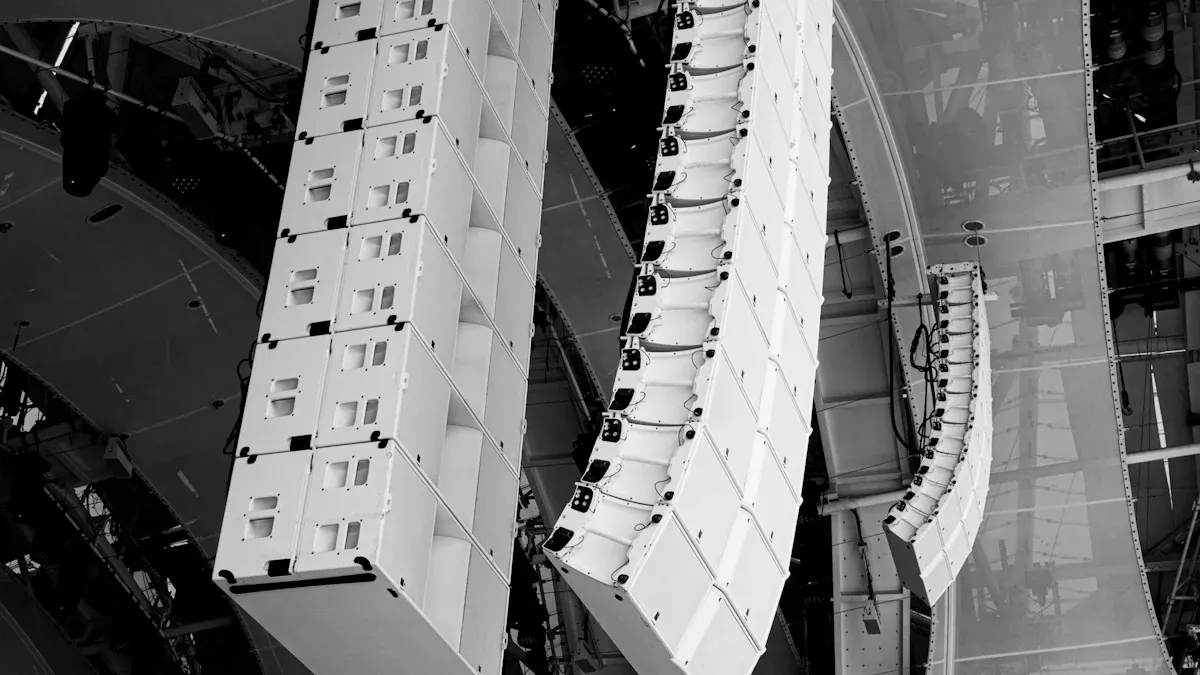
An aluminum truss system carries the equipment that defines your event: lights, speakers, and screens. You must plan every mount against the truss's rated capacity. GF-Truss publishes load data for each model so you can verify your rig before you build.
Lighting Rigging
You mount lighting fixtures with approved clamps, follow proper tightening procedures, and attach an independent safety cable to every fixture. A correctly loaded truss can still drop a poorly mounted light. Verify the total weight of fixtures, cables, and rigging hardware before you hang anything. Distribute fixtures evenly along the span and avoid concentrated loads that stress localized sections. Position heavy lighting positions directly above or near vertical supports. This single habit improves safety without changing your equipment list.
Load type matters as much as total weight. Dead load covers the truss, hardware, and fixed fixtures. Live load covers movable lights and repositioned equipment. Environmental load covers wind and snow, and you account for it separately. A point load at midspan creates the worst-case bending moment, so check the deflection column alongside the load column. The lower value governs your safe working load.
Audio and Video Mounting
Audio and video gear adds concentrated weight at specific points. A 200 lb projector rigged dead center of a 20-foot truss acts as a midspan point load, and you must evaluate support spacing for that condition. Match the truss size to the load:
| Truss Size | Typical Load Capacity |
| 290 mm aluminum truss | 100–300 kg |
| 400 mm aluminum truss | 300–1000+ kg |
Stay below the maximum rated load and apply the required safety factors. Capacity varies with span length, material grade, and static versus dynamic loading. GF-Truss helps you confirm the right model for your audio and video rig.
Safety and Load Ratings
Understanding Load Ratings
A load rating tells you the maximum weight an aluminum truss system can safely carry under defined conditions. You must read the rating for your exact span, load pattern, and orientation. Never substitute one manufacturer's chart for another. Independent certification backs up these numbers. GF-Truss uses TÜV-certified materials and welding craftsmanship, and its production passes strict quality control to earn the TÜV stamp of approval.
| Certification | What It Signifies for Load Ratings |
| TÜV | Independent testing against strict global safety standards; certificates carry a unique verification code and annual factory re-inspection |
| EN 1090-1 | European conformity for load-bearing structural components |
| EN 1090-3 | European standard for aluminum load-bearing structures |
| ISO 9001 | Quality management system certification |
| SGS | Third-party factory audit and product verification |
| CE | European conformity marking for the EU market |
German TÜV is the more authoritative product testing and certification for aluminum alloy truss. It covers raw materials, structural design, welding, mechanics verification, load-bearing performance, and traceability, with annual factory re-inspection.
Inspection and Maintenance
You protect your crew and your equipment with a disciplined inspection routine. Follow three inspection tiers:
· Initial inspection — complete it when you acquire a truss, and keep detailed records.
· Frequent inspection — run visual checks before each use and after any incident.
· Periodic inspection — schedule annual visual inspections by a competent person, with dated records on file.
Check truss geometry for twisting, bending, or sweep. Look for dents, cracks, or missing members. Verify connection flatness and hardware grade. Remove any truss with material loss above 25% of wall thickness or cracked welds. Clean with pH-neutral soap after every event, store in a dry space below 60% humidity, and replace damaged components immediately. GF-Truss supports you with documented load data and matched replacement parts.
Indoor vs. Outdoor Applications
Indoor Event Considerations
Indoor venues give you controlled conditions, but space restrictions can be significant. You must assess ceiling height, access routes, floor loading capacity, audience areas, and stage dimensions before you finalize any layout. A modular aluminum truss system adapts to these limits, so you can customize the build to the venue's exact dimensions and technical requirements. Distinguish point loads from distributed loads during planning. Spread lighting evenly along a span to improve safety. Match every shackle, clamp, and safety cable to the truss's certified load capacity. GF-Truss publishes load data for each model, which simplifies this check. Always consult a certified rigger or structural engineer to confirm compliance with local safety regulations.
Outdoor and Weather Considerations
Outdoor builds add environmental forces that indoor work never faces. You must perform wind load calculations for every setup and anchor each truss to ground support systems engineered for heavy-duty applications. Weather-resistant aluminum construction resists corrosion in both indoor and outdoor use. Conduct a site survey before assembly to identify anchor points, ground-bearing capacity, and obstruction clearances.
| Requirement Area | Recommended Practice |
| Environmental conditions | Account for wind, moisture, and uneven ground during planning |
| Wind loading | Calculate wind loads and secure ground supports |
| Corrosion resistance | Specify weather-resistant aluminum construction |
| Structural stability | Anchor trusses to engineered ground support systems |
After each event, inspect welds, node bolts, and connection hardware. Clean surfaces to prevent corrosive buildup, and replace worn clamps or safety wires immediately. GF-Truss builds outdoor-rated systems with these conditions in mind.
Custom Truss Fabrication
When Custom Solutions Make Sense
Standard truss modules cover most event builds. Some projects demand a shape or span that catalog parts cannot deliver. You should consider custom fabrication in several clear cases. A venue has unusual dimensions or obstructions that block a standard layout. Your design calls for a curved arch, a non-standard corner angle, or an irregular footprint. You need a dedicated structure for a permanent installation or a recurring show. Custom fabrication also makes sense when you want to reduce assembly time on a complex build. GF-Truss engineers custom pieces to match your drawings and your load requirements.
Design and Specification Tips
Start with the load case, not the shape. Define every fixture, screen, and speaker weight before you sketch the frame. Specify the alloy grade and tube dimensions so the fabricator can verify capacity. Share accurate site drawings with ceiling heights, anchor points, and access routes. State your connection preference, spigot or bolted, so the custom section joins your existing inventory. Request load charts and certification documents with the quote. Confirm lead times against your event calendar. GF-Truss reviews each custom aluminum truss system against your load data and provides documented ratings before production begins.
Sourcing Considerations
Evaluating Suppliers and Certifications
You should verify supplier credentials before you commit to any aluminum truss system. Ask for TÜV, EN 1090, ISO 9001, and SGS documentation, and confirm each certificate carries a valid verification code. GF-Truss holds TÜV certification for materials and welding, and its factory passes annual re-inspection. Request load charts for the exact models you plan to buy. A supplier with technical expertise helps you match truss capacity to your rig. Check that the supplier stocks matched connectors and replacement parts, because mixed hardware undermines structural integrity.
Lead Times, Shipping, and Support
Delivery schedules decide whether your build stays on track. GF-Truss manufactures components in days rather than the weeks or months other suppliers normally require, and average build time runs six weeks or less from start to finish. Specialized packaging needs can add delay depending on order volume, so confirm packaging requirements early.
| Consideration | Detail |
| Typical lead time | Components manufactured in days |
| Average build time | Six weeks or less |
| Delivery performance | Orders completed ahead of expectation, even in peak season |
| Packaging | Specialized packaging can affect timing |
| Shipping efficiency | Efficient manufacture and shipping protect your event date |
Standardized connections support fast work on site:
· Spigot or bolt connections with pins and clips
· Pre-engineered components for precise fit
· Tool-free or minimal-tool assembly
· Repeatable setup that cuts labor and setup time
GF-Truss supports your project with documented load data, matched parts, and responsive technical guidance.
Match your aluminum truss system to the job. Weigh five factors: truss type, material, connections, load ratings, and environment. The right match delivers safety and efficiency on every build. Consult a supplier with real technical expertise before your next project.
FAQ
Q: How Do You Verify an Aluminum Truss Load Rating?
A: Read the manufacturer's chart for your exact span, load pattern, and orientation. GF-Truss publishes TÜV-backed load data for every model. Never substitute another brand's chart.
Q: Which Connection Style Should You Choose?
A: Pick spigot connections for fast touring setups and bolted connections for rigid, long-term installs. GF-Truss supplies both styles with matched hardware, so your inventory stays compatible.
Q: Can You Use the Same Truss Indoors and Outdoors?
A: Yes, with preparation. Aluminum resists corrosion in both settings. For outdoor builds, calculate wind loads, anchor to engineered ground supports, and rinse connectors after coastal events. GF-Truss builds weather-ready systems.